The Royal Game of Ur: a race game from ancient Mesopotamia
How boards found at Ur and a Babylonian clay tablet let people play a 4,500-year-old race game again, with its route, rosettes and odds explained.

On this page
Some of the oldest known game boards in the world were found in a royal cemetery in southern Mesopotamia. They belong to a race game that is now called the Royal Game of Ur, after the city where they were dug up. Thanks to those boards and a much later clay tablet, people can play the game again today, and it takes only a few minutes to learn. You can print a board with routes and pieces from the Royal Game of Ur maker.
Boards from a royal cemetery
In the 1920s, the archaeologist Leonard Woolley excavated the Royal Cemetery at Ur, in present-day southern Iraq. Among the finds were several game boards with the same layout of twenty squares, some richly decorated with shell and coloured stone. They date to roughly 4,500 years ago. One of the finest is in the British Museum.
Boards with the same layout have been found far beyond Ur, and the game seems to have been played across the ancient Middle East for a very long time.
How the rules came back
The boards survived, but their rules did not travel with them. Much later, around 177 BC, a Babylonian scribe wrote a cuneiform tablet describing a game on the same board. Irving Finkel of the British Museum studied that tablet and published a reconstruction of the rules. Most modern ways of playing follow his reconstruction or simplify it, so it is fair to say that today's rules are a careful modern interpretation rather than a certain record of how the game was played at Ur.
The board and the route
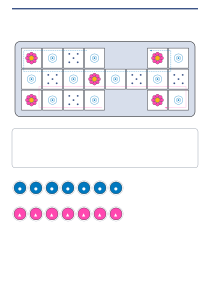
The board has three rows. The middle row is shared and eight squares long. The outer rows belong to one player each and are broken into a block of four squares and a block of two, with a gap between them. Five squares carry a rosette.
Each player's pieces enter their own row, move along it to the end, cross the whole shared middle row, then come back along their own short row and leave the board. That makes a route of fourteen squares.
The middle row is where the action is. Pieces from both sides pass through it, and that is the only place where they can capture each other.
Rosettes and captures
In the common modern rules, landing on a rosette gives you another throw. In the middle row, landing on an opponent's piece sends it back off the board to start again. The rosette in the middle of the shared row is safe: a piece standing there cannot be sent back. These two rules make the central rosette the most valuable square on the board, and a lot of the game is about reaching it and staying there.
Throwing four coins
The game was played with four small pyramid-shaped dice, each with two marked tips. On a printed board, four coins do the same job: count the heads. Because each coin is heads or tails with equal chance, the totals are far from equal.
There are sixteen equally likely ways for four coins to land, and six of them give exactly two heads. A throw of 2 is therefore the most likely result, and planning around it is the beginning of strategy. On Paperoom's version, a throw of 0 means you miss your turn.
Playing a first game
Each player has seven pieces. Take turns throwing and moving one piece by the number thrown. You must land exactly, a square holds only one piece, and you leave the board with an exact throw. The first player to bring all seven pieces home wins.
Tip: Early on, try to keep one piece on the central rosette. It is safe there, it blocks your opponent from using the square, and it gives you an extra throw whenever you land on it.
The printed board shows each player's route as a dashed line, so new players can see where their pieces go, and the cut-out pieces mean the whole game fits on a couple of sheets of paper.