Alquerque: the ancestor of checkers
Alquerque, the 5 by 5 board game from the Arabic al-qirq, its mention in Alfonso X's 1283 Book of Games, its basic rules and its link to draughts.


On this page
Alquerque is an old board game with a simple grid and a lively set of jumps. Its name comes from the Arabic al-qirq. The game is mentioned in the 10th-century Arabic Kitab al-Aghani (Book of Songs). It is also described in the Libro de los juegos (Book of Games), made for King Alfonso X of Castile in 1283. That book covers many games, including chess and dice. It is known for the illustrations that accompany its text, which is one reason historians study it closely.
Alquerque is widely considered an ancestor of draughts, which is also called checkers. It is a good example of how games travelled between cultures and changed along the way.
The board and the pieces
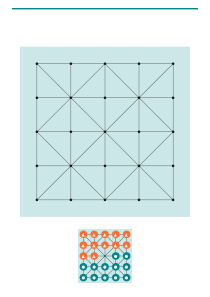
Alquerque is played on a 5 × 5 grid of points, with diagonal lines crossing the board. Each player has twelve pieces. The usual setup places pieces on the two rows nearest each player, plus the two outer points of the middle row, which leaves the centre empty. The empty centre means the first moves open up the middle of the board, where most early contact happens.
Basic rules
These are the common rules, as the game is usually played:
- Moving. A piece moves along a line to an adjacent empty point. Diagonal moves are allowed only where diagonal lines exist.
- Capturing. A piece captures an enemy piece by jumping over it along a line, landing on the empty point directly beyond.
- Multiple jumps. If the landing point allows another jump, the same piece may keep jumping in the same turn, removing more enemy pieces.
- Compulsory captures. Some versions require a capture whenever one is available. Others leave it optional. Agree on this before you start.
- Winning. A player wins when the opponent has no pieces left or cannot move.
Tips for a first game
Keep your pieces together. A piece with a friendly piece directly behind it cannot be jumped from the front along that line, because the landing point is occupied. Before each move, check which of your pieces become exposed and which empty points your opponent could use to jump.
Because multiple jumps are allowed, a single capture can open a path for several more. Look at where a jump would land and whether the same piece could go on jumping from there, before you start a sequence of your own. A jump is not always the best move, so compare it with the position it leaves behind before you take it.
The link to draughts
Draughts is played on an 8 × 8 board, and its pieces move diagonally and capture by jumping. Alquerque shares that jumping idea and its use of diagonal lines, which helps explain why it is so often linked to draughts. The two games are not identical, and the rules of each have changed over time, but the family resemblance is clear to anyone who plays both. Players who already know draughts will recognise the shape of a capture quickly, which makes alquerque an easy second game to learn.
Playing on a printed board
You can draw a 5 × 5 grid with its diagonals, or print the board from Paperoom's alquerque maker. Use two colours of coins, buttons or bottle caps, with twelve of each, and leave the centre point empty. A sheet of paper is enough for a game at a kitchen table. Keep the spare pieces in a small dish so they do not roll off the table.
Print at 100% scale, match the paper size to your printer, turn off the browser's headers and footers, and check one test sheet first. This is especially useful for alquerque, because the diagonal lines must meet the points exactly for the jumps to look right.
A printed grid also suits other old games. Nine men's morris uses a different board shape, but it is another game that rewards careful reading of lines. Try both on the same afternoon and compare how each one feels to play.