Dots and Boxes: La Pipopipette and the Art of the Chain
How Édouard Lucas published La Pipopipette in 1889, how to play dots and boxes, and the strategy of safe moves, chains and the double-cross.

On this page
A French mathematician's pencil game
In 1889 the French mathematician Édouard Lucas published a game called La Pipopipette. Today many people know the same idea as dots and boxes. It needs only paper and two pencils, and it is still played in many classrooms and kitchens.
The rules
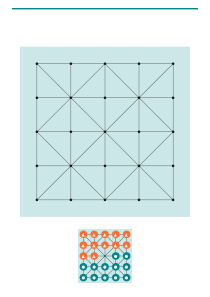
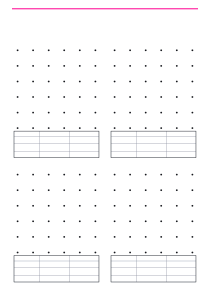
Draw a grid of dots. A grid of five dots by five makes sixteen boxes, which is a good first game. Players take turns:
- Draw one horizontal or vertical line joining two neighbouring dots.
- If that line completes the fourth side of one or more boxes, write your initial in each of them and draw again.
- If it completes no box, your turn ends.
The game ends when every line has been drawn. The player with more boxes wins. Most games are for two players. With more, give each player a different pencil colour so the initials are easy to read.
Do not draw the third side
Early in the game almost any line is safe. A move is unsafe when it leaves a box with three sides drawn, because your opponent can then complete that box and move again. The first rule of strategy follows from this: do not draw the third side of a box.
Keep safe moves for as long as you can. Every safe line you draw is one fewer that your opponent can use, and once the safe lines run out, someone has to give something away.
Counting chains
As the board fills, the safe lines run out. Boxes with two sides drawn start to link into chains: rows of boxes where each box leads to the next through an undrawn line. A chain can be short (one or two boxes) or long (three or more). Whoever has to draw a line that opens a chain gives the opponent the chance to take its boxes.
To find the chains, look at each box with exactly two sides drawn and follow its undrawn sides to the next box. Trace the path with a finger or the tip of a pencil. A closed ring of boxes is a loop rather than a chain, and it plays a little differently, so count loops separately.
So in the endgame, count. Note how many chains remain, how long each one is, and who will have to move when the safe lines are gone. Opening a short chain costs little. Opening a long one can cost many boxes, unless you have a way to keep control.
Tip: do not spend effort on chain counting early in the game. Keep the board safe, and count once only a few safe lines remain.
The double-cross
Here is the trick that keeps control. Suppose your opponent opens a two-box chain by drawing its outer edge. Box A now has three sides. Box B, beside it, has two.
If you simply take A, by drawing the line between A and B, box B gets its third side and you can take it too. But then you must draw again, and you may be the one forced to open the next chain.
Instead, you can decline both boxes. Draw the outer edge of box B. Now both boxes have three sides and share one undrawn line between them. Your opponent draws that line, which completes both boxes with a single stroke. That single line is the double-cross. Your opponent gets two boxes, but must draw again, so control passes back to you.
Try it with pencil on paper as you read, and it becomes clear quickly.
The same idea works on a long chain. You take all but its last two boxes, then decline the final pair with a double-cross. Giving up two boxes can be worth it when the next chain is long.
A short checklist
- Keep safe lines while they last.
- Count the chains as the safe lines run out.
- When you must open something, open the shortest chain you can.
- Use a double-cross when your opponent opens a long chain and you want to keep control.
If you would rather not draw the grid by hand, you can look for a printable one in Paperoom's dots and boxes maker.