Royal Game of Ur maker
A race game from ancient Mesopotamia: a 20-square board with rosettes, each player's route and pieces to cut out.
2 players15–30 minAges 7+Arab world & Middle East
Download a PDF directly, or print at 100% in portrait with browser headers and footers off. Match your paper size. PDF fonts load from this site on your first download. Your game content stays on your device.
Your PDF is ready. Want a whole game night in one file?
The Royal Game of Ur was played in ancient Mesopotamia about 4,500 years ago. Paperoom prints the 20-square board with each player's route, seven pieces for each side and a rules box. The rules follow a modern reconstruction, so families often adapt them.
How to play
- Toss four coins and count the heads. That number is how far you move one piece. In this version, no heads means you miss your turn.
- Each route runs along your own row, across the shared middle row, and back along your own row to the exit.
- You must land exactly. A square holds one piece, so you cannot land on your own piece either.
- In the middle row, landing on an opponent's piece sends it back off the board. The middle rosette is safe: no piece there can be sent back.
- Landing on a rosette gives you another throw.
- Bear off with the exact number. The first player to get all seven pieces home wins.
Tips
- Four coins give the same spread of 0 to 4 heads as the original four tetrahedral dice, and they are easier to find.
- Before the first throw, trace the arrows: the blue route runs along the top row and the pink route along the bottom row.
- Keep pieces that are off the board in a cup beside you, so you can bring them in quickly.
- Agree on the exact-landing and no-heads rules before you start, because families play them differently.
Where it comes from
Leonard Woolley excavated boards in the Royal Cemetery at Ur, in present-day southern Iraq, in the 1920s. The game was played in ancient Mesopotamia about 4,500 years ago. Irving Finkel of the British Museum reconstructed rules from a cuneiform tablet written around 177 BC by the Babylonian scribe Itti-Marduk-balāṭu. Modern rules are a reconstruction, and many families use simplified versions.
Played in: Arab world & Middle East
Questions
Are these the original rules?
Nobody can be certain. The rules here follow a modern reconstruction built from a cuneiform tablet and excavated boards, and many families play their own versions.
Why four coins instead of dice?
The original throws used four tetrahedral dice, with two of the four tips marked. Four coins give the same 0 to 4 spread with the same odds, so nothing else is needed to play.
What do the rosettes do?
Landing on a rosette gives you another throw. The rosette in the middle of the board is safe, so no piece there can be sent back.
How many players and pieces are there?
Two players with seven pieces each. The pieces page has seven blue and seven pink counters, each marked with its own shape.
You might also like
 Board games to print
Alquerque
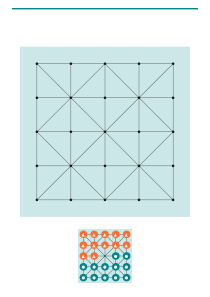
A two-player game of moving and jumping on a five-by-five board, with a starting-position diagram and 24 counters to cut out.2 players10–30 minAges 7+ Board games to print
Ludo
Four coloured yards and a race round the cross. Print the board, counters and a paper die, then roll for a six.2–4 players20–60 minAges 5+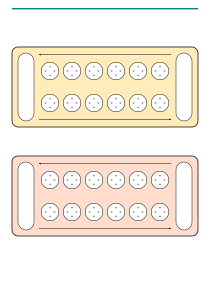 Board games to print
Mancala (Oware, Kalah, Congkak)
Two rows of pits and a handful of seeds. Print oware, kalah or congkak boards, with optional seed tokens to cut out.2 players10–30 minAges 6+ Board games to print