From tic-tac-toe to gomoku: winning lines on paper
Forks in tic-tac-toe, the sending rule of ultimate tic-tac-toe and the open four of gomoku, with tips for playing each on a printed board.

On this page
Three in a row, four in a row, five in a row: the same simple idea runs through a whole family of pencil games. The bigger the board and the longer the line, the more room there is for real strategy. This guide moves from the classic 3 × 3 grid to ultimate tic-tac-toe and gomoku, with one key idea for each. Boards for all three are on the tic-tac-toe maker and the gomoku and Go board maker.
Tic-tac-toe: the fork
Two experienced players almost always draw at tic-tac-toe, because careful play from both sides is enough to prevent a line. Most wins come from a fork: a move that makes two threats at once. Your opponent can block only one, so the other becomes three in a row.
Corners are useful for building forks, because each corner sits on three lines: a row, a column and a diagonal. The centre sits on four lines. When you defend, look one move ahead: block not only lines with two marks, but also moves that would let your opponent build two threats at once.
Ultimate tic-tac-toe: where you send your opponent
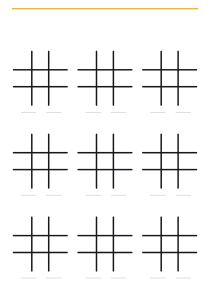
Ultimate tic-tac-toe is played on nine small boards arranged in a big 3 × 3 grid. You win a small board by getting three in a row on it, and you win the game by winning three small boards in a row.
The twist is the sending rule. The square you play in, inside a small board, decides which small board your opponent must play in next. If you play in the top-right square of any small board, your opponent must play somewhere in the top-right small board.
This turns every move into two decisions: what the move does on its own board, and where it sends your opponent. Sending them to a board they are about to win is a common mistake. When a player is sent to a board that is already won or full, a common rule lets them play on any open board instead, and players should agree on this before starting.
Gomoku: the open four
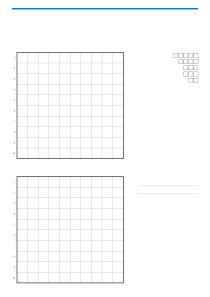
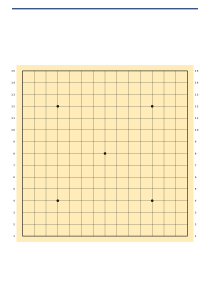
Gomoku is five in a row, usually played on the intersections of a 15 × 15 grid, the size Paperoom prints for it. It is also called wuziqi in Chinese. With so much space, short threats grow into long ones, and the most important shape to recognise is the open four.
An open four is four stones in a row with an empty point at both ends. Your opponent can block one end, but you complete five at the other, so an open four wins. A four with one end already blocked is still a threat that must be answered, but it can be stopped with one stone.
The same thinking applies one step earlier. An open three, three in a row with space on both sides, threatens to become an open four, so it usually needs an answer at once. Strong players build two threats at the same time, the gomoku version of a fork.
Why rules change at the top level
In freestyle gomoku, the first player has a large advantage, and computer analysis in the 1990s showed that the first player can always win on a 15 × 15 board with perfect play. Tournament play therefore often uses renju, a variant that restricts some of the first player's moves, or special opening rules. For a casual game on paper, simply take turns going first.
Playing on paper
- Use two clearly different marks or colours, and check that both players can see the whole board.
- On a gomoku board, players can use X and O, two pens, or coins and beans placed on the intersections.
- Print boards with coordinates if you want to record a game or talk about a move, such as H8 for the centre of a 15 × 15 board.
- For younger players, start with classic tic-tac-toe, then try the big 6 × 6 board where four in a row wins, before moving on to gomoku.
Tip: Keep a tally row under each board. Over a run of games, you will see whether going first really helps at each size.