Hex: the game that can never end in a draw
Invented twice in the 1940s, Hex has one of the cleanest rule sets of any board game. Why someone always wins, and the bridge, its first trick.

On this page
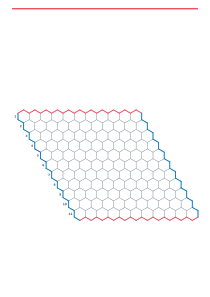
Hex has almost no rules. Two players take turns colouring hexagons on a rhombus-shaped board, and each tries to connect their own two opposite edges. There are no captures, no moves after placement and no special cases. Yet the game has fascinated mathematicians for decades, and it has a property few games share: it can never end in a draw. Print a board in any of four sizes from the Hex maker and play along.
Invented twice
Hex was invented by the Danish designer and poet Piet Hein, who introduced it in 1942. Around 1948, the American mathematician John Nash, then a student at Princeton, came up with the same game independently, and it became a favourite in the university's common room. A commercial version later appeared in the United States under the name Hex, which is the name the game kept.
The rules
The board is a rhombus of hexagons, often 11 × 11. One player takes red and owns the top and bottom edges; the other takes blue and owns the left and right edges. Players take turns colouring one empty hexagon. The first player to join their two edges with an unbroken chain of their own hexagons wins. Two hexagons are connected only when they share a side.
Why there is never a draw
Imagine the board completely filled in. Either red has a chain from top to bottom, or blue has a chain from left to right, and never both. The shape of the board makes this unavoidable: a red chain from top to bottom blocks every blue path from left to right, and if red has no such chain, the blue hexagons that stop red must themselves join left to right. Mathematicians have shown that this simple fact is closely related to the Brouwer fixed-point theorem, a well-known result in topology.
Since a full board always has exactly one winner, the game cannot end without a winner. In practice someone completes a chain long before the board fills.
The first player has the advantage
A classic argument, called strategy stealing, shows that the first player always has a winning strategy in Hex, on a board of any size. The argument shows only that such a strategy exists; it does not say what it is, and for large boards nobody knows it. Even so, starting first is a real advantage, especially with a central opening move.
Many players balance this with the swap rule, sometimes called the pie rule. After the first move, the second player may choose to take that move as their own. The first player then has every reason to open with a move that is neither too strong nor too weak.
The bridge
The first trick most Hex players learn is the bridge. Two of your hexagons that do not touch, but share two empty neighbours, are as good as connected. If your opponent fills one of the shared neighbours, you fill the other.
Bridges let you cover the board twice as fast as a chain of touching hexagons. A good early plan is to stretch a line of bridges across the board, then defend each one as your opponent attacks it.
Sizes for paper play
A 7 × 7 board makes a quick game and is good for learning the bridge. The 11 × 11 board is the traditional size and gives a full game. A 13 × 13 board takes longer and leaves more room for planning. Paperoom prints all of these, with optional coordinates so you can write down an interesting game and replay it later.
Tip: Use two pencils or felt-tips in clearly different colours. A thick mark in the centre of each hexagon is easier to read than shading the whole cell.