90-ball bingo
Independent 90-ball tickets with three rows, nine columns and 15 numbers each, plus a caller sheet for the 1–90 game.
2–60 players20–60 minAges 6+EuropeSouth Asia
Download a PDF directly, or print at 100% in portrait with browser headers and footers off. Match your paper size. PDF fonts load from this site on your first download. Your game content stays on your device.
Your PDF is ready. Want a whole game night in one file?
Each independent 1–90 ticket has three rows, nine columns, and 15 numbers: five per row. Columns follow the tens and increase downward. Tickets are not a six-ticket strip.
Call from your screen
Draws without repeats from this set’s list. Keep this page open to retain the draw history.
Tombala, the 90-ball game, uses numbered tickets from 1 to 90 instead of word grids. Paperoom prints independent tickets: each has three rows, nine columns and 15 numbers, five in every row, with each column using its own range of tens. The tickets are not a strip of six, so each one stands on its own.
How to play
- Give each player one or more tickets. Each ticket has 15 numbers, five in each of its three rows.
- Agree on the prizes before play begins, for example the first completed row, then two rows, then the full ticket. Confirm any house rules with the group.
- Cut the caller sheet into slips and shuffle them, or use the on-screen caller, which draws from 1 to 90 without repeats.
- Call each number clearly. Players mark it on their ticket if they have it.
- When a player completes an agreed pattern, they call it out, and the caller checks the ticket against the numbers already drawn.
- Continue until the agreed prizes are claimed, then start a new set. That resets the caller for the next game.
Tips
- Print one page as a test and check that two-digit numbers are clear at the size you have chosen.
- Large print with one ticket per page gives the largest numbers and the most room to mark them.
- Keep the caller sheet with the caller so the upcoming numbers stay hidden from the table.
- Give each player counters that are easy to pick up and large enough to cover a number without hiding the next one.
- Save the setup as a file, or note the repeatable seed, so the same set can be made again for a repeat game.
Where it comes from
Tombola is a traditional Italian family game with numbers from 1 to 90, and it is traditionally played at Christmas, especially around Naples. The same format is called housie in Britain, and tambola or housie in India. Lotto-style games in general are often traced to a 16th-century Italian lottery, though the links between them are not fully documented.
Played in: Europe · South Asia
Questions
How is a ticket laid out?
Each ticket has three rows and nine columns, with five numbers in every row and 15 in total. The first column holds 1 to 9, the next holds 10 to 19, and so on, with the last column holding 80 to 90. Numbers in each column increase from top to bottom, and every column has at least one number.
Are the tickets a six-ticket strip?
No. Paperoom makes independent tickets. It does not create a strip of six that uses every number from 1 to 90 exactly once, and each ticket in a batch is distinct.
How many tickets can I make?
Up to 60 different tickets in one set, printed one, two or four to a page. Large print uses one ticket per page.
Does the caller draw each number once?
Yes. The on-screen caller draws from the 90 numbers without repeats, and the printed caller sheet lists each number once. Starting a new set resets the caller. Keep the page open to retain the draw history.
Can I make the same tickets again?
Yes. A repeatable seed with the same settings recreates the identical set. Saved setup files store your settings, but generated tickets and caller history are not saved.
You might also like
 Bingo & calling games
Bingo
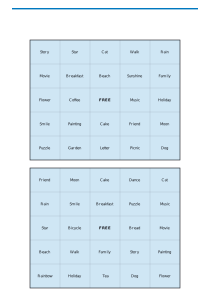
Word bingo on 3 × 3, 4 × 4 or 5 × 5 cards, or classic 75-ball number cards, with a caller sheet for each set.2–60 players15–45 minAges 4+ Bingo & calling games
Lotería
Mexican lotería for your own names: print tablas of 16 with a numbered caller's deck, then play with beans.2–30 players15–45 minAges 4+ Board games to print
Ludo
Four coloured yards and a race round the cross. Print the board, counters and a paper die, then roll for a six.2–4 players20–60 minAges 5+ Board games to print